I’ve pulled engines apart that failed the quiet way. No bang under the bonnet, just a piston running hot for months until the car starts drinking oil for no reason anyone can name. Usually, the tune was wrong from the start.
A custom dyno tune in Malaysia is the safest way to make power because it sets air-fuel ratio, ignition timing and boost to your specific engine, verified on a load-bearing dyno at Malaysian temperatures on the fuel you actually pump. A generic flash file assumes an average engine. Yours probably isn’t one.
The three variables that decide whether an engine lives
Every tune comes down to fuel, spark and pressure. Starve the engine of fuel for the air it’s pulling in and the burn runs hotter than the metal can take. That melts a piston edge or a ring land. A lean engine often feels sharper, right up until one hot afternoon finishes it.
Ignition timing is when the spark fires before the piston reaches the top of its stroke. Advance it and you make more power, up to a point. Push past that point and the fuel ignites on its own before the spark arrives. That’s knock, and it hammers pistons, rings and bearings. Knock reacts to fuel quality, intake heat and carbon build-up, so a map tuned in a cool overseas workshop can knock on RON95 in a 35°C jam here.
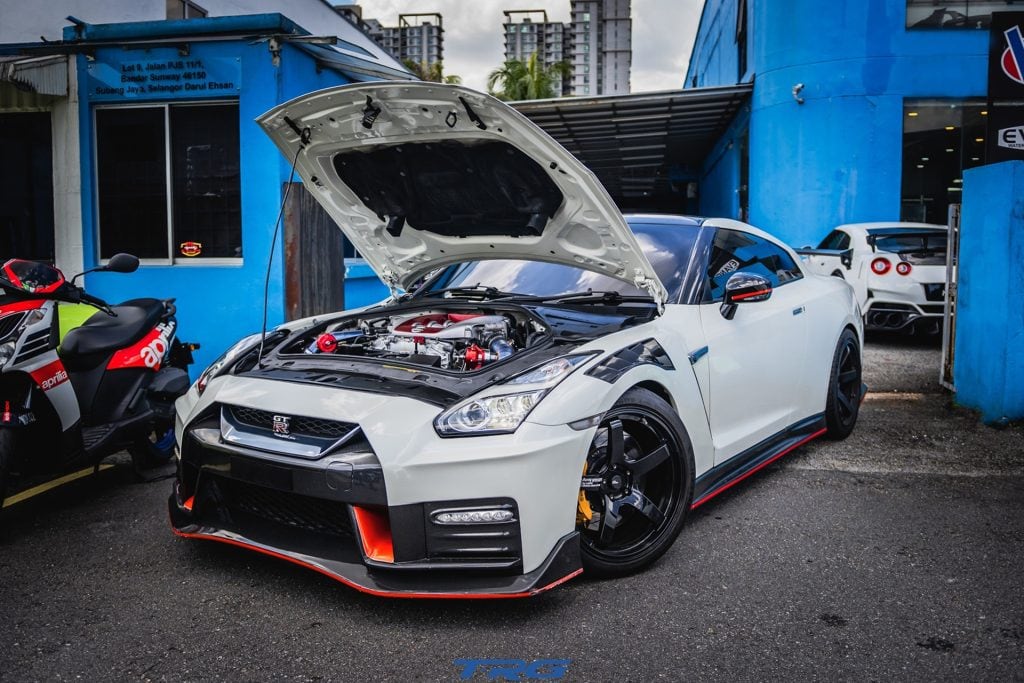
Boost is just more air forced in. It raises cylinder pressure and temperature, so it turns up the lean risk and the knock risk together. That’s why we never jump to a big number. On a GT-R we start boost at 1.0 bar and climb in steps, 1.1, 1.2, 1.3, watching air-fuel ratio and knock at each one.
How a custom dyno tune in Malaysia manages those three in practice
A proper tune isn’t one file dropped onto the car. It’s a loop, repeated until the numbers hold. We take a baseline pull, then change one thing: a touch of fuel, a degree of timing, a tenth of a bar. Measure. Read the trace. Listen for knock. Clean, next step. Wrong way, we back off.
Two things keep this honest. First, the dyno holds the car under real load instead of letting the wheels spin free. Ours is an in-house Mustang Dynamometer, all-wheel drive and load-bearing, good for 1,000hp pulls from morning till night. Second, the tune happens here, on the fuel you’ll actually pump. custom ECU tuning on our in-house dyno runs on this loop, on whichever platform the car calls for (EcuTek, MoTeC, Syvecs or Link ECU).
That’s why the same file can be safe in one car and dangerous in the next. A high-mileage engine with carboned-up valves and a tired fuel pump behaves nothing like a fresh one, and a custom tune measures the engine actually on the dyno, not an average engine somewhere else. Custom tunes last forever, I tell customers. Nothing beats them. The longer version is here.
Does your gearbox need tuning too?
On modern cars with a computer-controlled transmission, tuning doesn’t stop at the engine. The TCU decides how fast the box shifts and how much torque it lets through before it protects itself. Leave it stock after adding power, and either the torque limiter clamps down so you never feel what you paid for, or the shifts stay soft while the clutches take the beating. A TCU remap in Malaysia firms up the shifts, raises the torque limits sensibly, and sets launch behaviour. We calibrate the engine and the TCU together so the whole drivetrain agrees.
Frequently asked questions
Is a custom dyno tune worth it over a cheaper flash file?
For a healthy, stock or lightly modified car, a good flash file can be fine, and cheaper. Once you add real hardware, run an older engine, or want the last bit of safe power, a custom tune protects the parts you’ve already paid for.
What is a TCU remap and do I need one?
A TCU remap recalibrates the gearbox computer: shift speed, torque limits and launch behaviour. If you’ve added meaningful power to an automatic or dual-clutch car, you usually need one, or the box chokes your power or wears its clutches handling torque it was never set up for.
Can a tune damage my engine?
A bad tune can. Too lean and combustion runs hot enough to melt a piston. Too much timing and you get knock that hammers bearings and ring lands. Safe car tuning avoids both by measuring air-fuel ratio and knock on your actual engine and holding a margin back.
One honest caveat: a custom tune costs more and takes longer than a flash file you can buy over WhatsApp in ten minutes. If your car is stock and healthy, you might not need it yet. Once there’s real hardware on the engine, it stops being optional.
Ready to find out what your engine can safely handle? WhatsApp TRG to book a baseline dyno pull and a custom tune built for your actual car. Chat with us on WhatsApp.