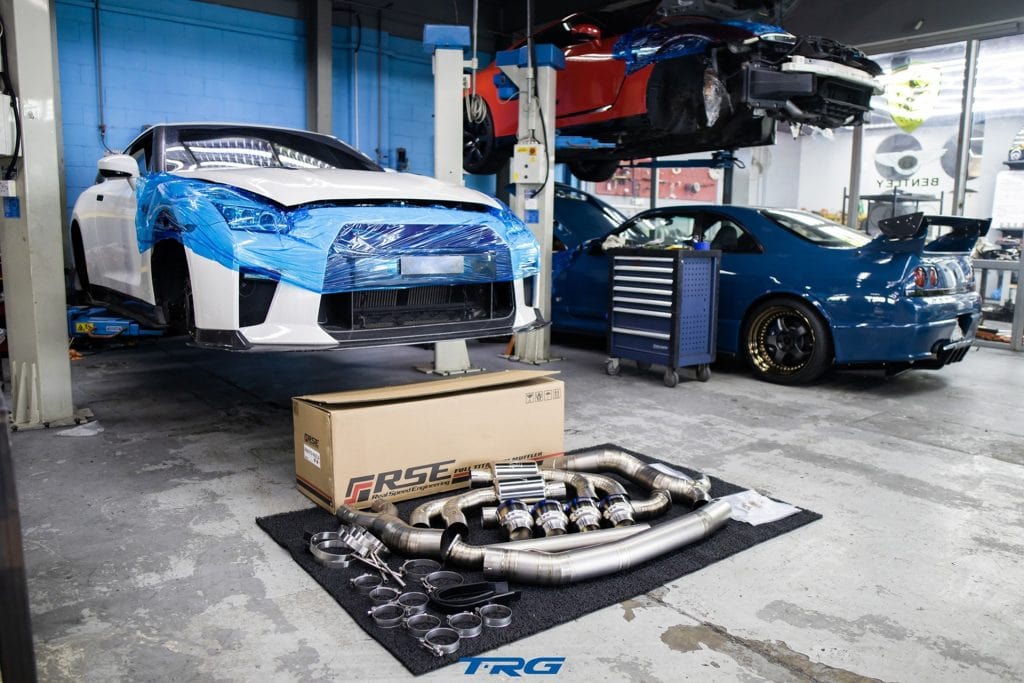
About half the R35 owners who WhatsApp us about GT-R tuning in Malaysia have already picked a stage number before I know anything else about the car. Mileage, service history, whether the gearbox has ever been cracked open: that comes after, if at all.
GT-R tuning in Malaysia breaks into three main stages. Stage 1 keeps the car fully stock and adds power through software alone. Stage 2 bolts on an air intake, downpipes and a custom tune, commonly landing at 600hp or more. Stage 3 changes the turbos, fuelling and supporting hardware for 800hp and up.
The stages aren’t an industry standard. We built them to match a budget to a horsepower goal, so one workshop’s Stage 2 rarely matches another’s. Ask what’s in the package, not just the number on the sticker.
What’s actually in each stage
A stock R35 makes somewhere between 480 and 570hp depending on the model year: earliest cars sit at the bottom of that range, later facelift cars at the top.
Stage 1 is software only. We recalibrate the factory ECU on our in-house Mustang dyno, within what the stock turbos and Malaysian RON97 allow.
Stage 2 bolts on an air intake, downpipes and a matching custom tune. It’s the package we build most: commonly 600hp and up, a harder exhaust note, earlier midrange, turbos left alone. Details on our ECU calibration service. Stage 2.5 squeezes the last safe margin out of the stock turbos.
Stage 3 means new turbochargers, and everything that changes with them: fuelling, supporting hardware, the works. Typical output is 800hp and up, and the ladder keeps climbing: full custom builds run well past 1,000hp. Our own Fatty Monster widebody sits around 1,000 to 1,006hp and has run 8.75 seconds in the quarter mile, so I know what living above Stage 3 demands.
| Stage | Hardware | Indicative power | Who it suits |
|---|---|---|---|
| Stock | Factory | 480 to 570hp (by year) | The baseline |
| Stage 1 | Software only, dyno tune | A step over stock | Fully stock look |
| Stage 2 | Air intake, downpipes, tune | Around 600hp and above | Daily drivers wanting sound and shove |
| Stage 2.5 | Stage 2 plus bolt-ons | Between Stage 2 and Stage 3 | Maxing the stock turbos |
| Stage 3 | Turbos, fuelling, supporting hardware | 800hp and above | Track and drag |
The part the stage sticker leaves out: gearbox and cooling
The GR6 dual-clutch gearbox is the R35’s weak point. Torque kills the gearbox long before it touches the VR38 engine. From Stage 3 up, and on hard-driven Stage 2.5 cars, we reinforce the GR6 with Dodson Motorsport parts. Dodson rates its Level 1 gear set at 1,500hp; I have never broken one. We keep roughly 95% of Dodson’s GR6 catalogue in-house, so a build doesn’t wait on an import, and the details live on our GR6 gearbox service page.
Cooling is the other requirement nobody asks about. More power means more heat, and a 35°C afternoon in the Sepang pit lane doesn’t care about your build sheet, so budget for it at the higher stages or watch the power fade after two hard pulls. Every GT-R build we deliver carries our warranty of up to 30,000 km.
How much does GT-R tuning in Malaysia cost?
Pricing scales with hardware, and two identical-looking R35s can need different budgets. A 2009 car with 120,000 km and no service history needs a health check first, maybe a gearbox service, before it sees a single extra bar of boost. We look at the car before we quote.
Frequently asked questions
How much horsepower does a stock R35 GT-R make?
Stock output runs roughly 480 to 570hp depending on the model year, earliest cars lower, later facelift cars higher. Malaysian heat and fuel quality shift the real number either way, which is why we baseline every GT-R on our dyno before we plan anything.
Is a Stage 2 GT-R still reliable as a daily driver?
Yes, provided the engine is healthy and the tune was built on a dyno instead of flashed blind. An intake, downpipes and roughly 600hp sit comfortably within what the VR38 can handle daily. Keep an eye on gearbox behaviour as the kilometres climb.
What is the difference between a custom tune and a cantune?
A cantune is a generic flash file copied onto your ECU with zero checks on your engine’s condition. A custom tune is built on the dyno for your car specifically, boost raised from 1.0 bar step by step while we watch air-fuel ratios and knock.
Bring the car in and we’ll tell you which stage matches your goals, and separately, which stage your car can actually take. Those two answers don’t always line up. Start with our GT-R service and tuning page or message us directly.
Not sure which stage is right for your GT-R? WhatsApp TRG with your car’s mileage and history, or visit our GT-R service page to see how we build each stage. Chat with us on WhatsApp.